

Sanitizing ambulances with Ozone: why SANIOZON 500 remains the most effective technology
Comparison of Ozone, HEPA filters, bipolar ions, photocatalysis, and other sanitization systems for ambulances

In recent years, ambulance sanitization has become increasingly central to the safety of healthcare workers and patients.
There are various technological solutions available on the market for sanitizing the sanitary compartment, but not all guarantee the same level of effectiveness and completeness.
In this article, we clarify the situation by comparing the main technologies used today – from HEPA filters to photocatalysis – to understand why Ozone, and in particular Protea’s SANIOZON 500 system, remains the most complete and natural choice for onboard ambulance sanitization.
ozone
X HEPA filters: great for air, but not for surfaces X
HEPA (High Efficiency Particulate Air) filters are often cited as a solution for “sanitizing” ambulances.
In reality, it’s a matter of filtration: HEPA filters trap airborne particles (such as dust and aerosols), but they don’t eliminate viruses, bacteria, or mold deposited on the surfaces of the ambulance.
In an ambulance, where instruments, handles, seats, and stretchers are constantly touched, it is precisely on the surfaces that most microorganisms accumulate.
For this reason, a system that only acts on the air is insufficient to guarantee complete sanitization.
ambulance sanitization
X Bipolar ionization: useful but difficult to control X
Bipolar ion technology (or “cold plasma”) aims to purify air by generating positive and negative ions that interact with contaminants.
Although useful for reducing odors or volatile organic compounds, the actual effectiveness on viruses and bacteria is difficult to measure and highly dependent on environmental conditions.
Furthermore, ionization only acts where the air passes, without reaching corners, surfaces, or hidden areas of the vehicle.
In other words, it is a partial treatment that can complement, but do not replace, actual sanitization.
ozonizer
X Photocatalysis: a good idea, but with practical limitations X

Photocatalysis uses UV light combined with special surfaces (usually titanium dioxide) to degrade organic substances and bacteria.
It’s an interesting technology, but it’s only effective in static, well-lit environments, where light constantly reaches the catalytic surface.
Inside an ambulance, where surfaces and instruments change position and shadows, photocatalysis cannot guarantee uniform action.
Again, it’s a support, not a complete solution.
ambulance disinfection
✓ Ozone: the natural solution that sanitizes air and surfaces ✓
Ozone (O₃) is a natural molecule with a high oxidizing power, capable of quickly and safely neutralizing bacteria, viruses, mold, and unpleasant odors.
Its main advantage is its ability to reach every corner of the sanitary compartment, even the most difficult to treat manually.
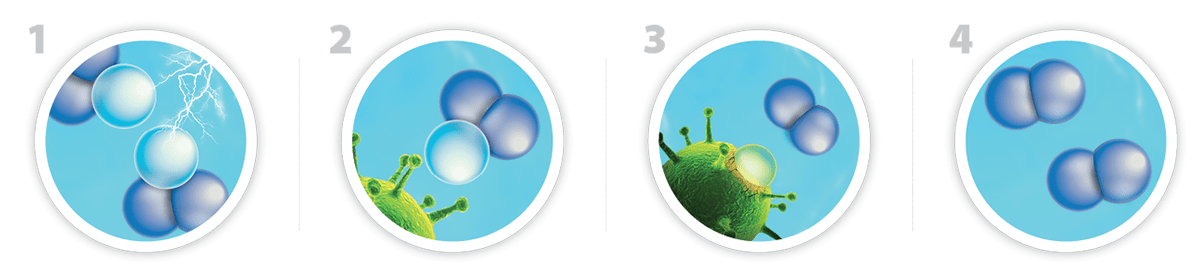
However, while Ozone is simple to generate, it is complex to manage correctly: concentrations, times, and methods must be precisely calibrated. This is why it is essential to rely on qualified and experienced companies in the sector, capable of dosing the right amount of ozone to achieve deep sanitization without damaging materials or internal components.
Here are the main advantages of Ozone sanitization, when properly managed:
- Effective on air and surfaces: it truly eliminates microorganisms, not simply filters.
- No chemical residues: Ozone naturally reconverts into oxygen.
- Safe on materials: with the Protea protocol, maximum effectiveness is achieved without side effects.
- It reaches every corner of the sanitary compartment, even those inaccessible to traditional systems.
ozone systems
✓ SANIOZON 500: professional sanitization for emergency vehicles ✓
SANIOZON 500, designed and manufactured by Protea Srl, is a specific solution for the automatic sanitization of ambulances, emergency vehicles, and special vehicles.
Compact, quiet, and designed for built-in installation, it allows for thorough sanitization of the sanitary compaertment in just a few minutes, without the need to disassemble or move any components.
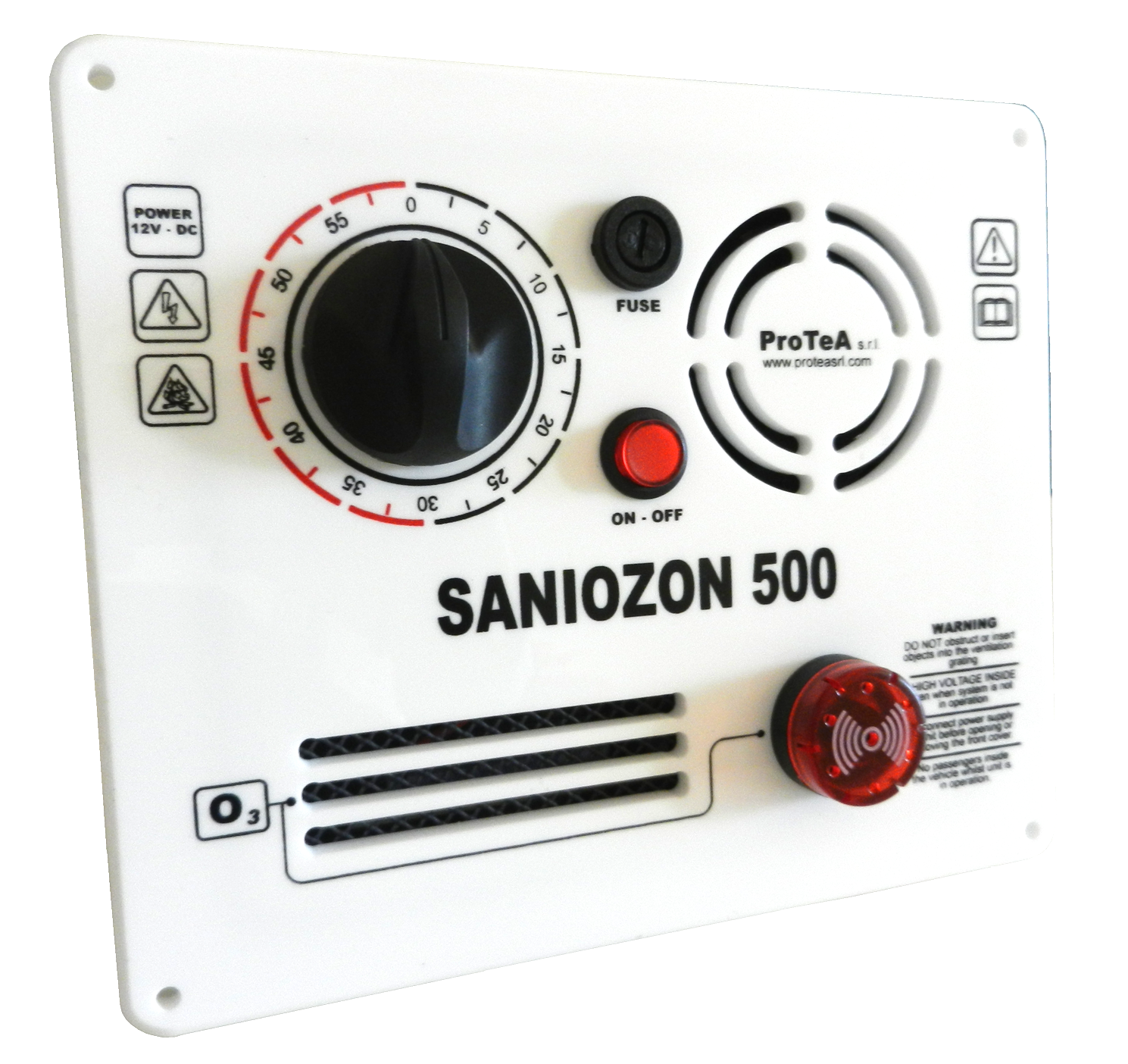
Compared to portable generators, SANIOZON 500 offers unique advantages:
- Quick (20 min) and effective sanitization, even in the most difficult-to-reach spaces.
- Highly effective against a broad spectrum of bacteria, viruses, and odors.
- Built-in installation, integrated into the bathroom cabinet.
- No recharging or consumables: uses only the vehicle’s power supply (12V).
- Treatment can be activated anywhere, even without returning to the operating base.
- E49 automotive-certified system, compliant with industry safety standards.
Relying on SANIOZON 500 means adopting a tested, professional and safe technology, capable of guaranteeing hygiene, efficiency and operational continuity with every intervention.
photocatalysis
Conclusion: Onboard safety starts with sanitization
HEPA filters, bipolar ions, and photocatalysis can help improve air quality, but only Ozone guarantees complete sanitization of the medical compartment.
For those who build or operate emergency vehicles, choosing the right technology means protecting workers and patients, ensuring consistently high hygiene standards.
ozone ambulances
Find out more about SANIOZON 500
Visit the dedicated page on the Protea website
Or contact us to receive the technical data sheet and personalized advice.


